Medicare Primary vs. Secondary Payer — Who Pays First?
If you have Medicare and another type of health or drug coverage, it’s important to know who pays first. Getting this wrong can lead to billing delays, denied claims, or unexpected medical costs.
Many people are surprised to learn that Medicare does not always pay first. Others assume their employer insurance always takes priority — and that isn’t true either.
The order of payment depends on:
Your age
Whether you’re actively working
Your spouse’s employment status
Employer size
Disability status
Whether your insurance is retiree coverage
This guide breaks everything down simply so you always know which insurance pays what — and how to avoid billing mistakes.
What Does “Primary” and “Secondary” Mean?
Each type of insurance you have is called a payer. When you have more than one payer, Medicare uses coordination rules to determine:
Primary Payer: The plan that pays the bill first
Secondary Payer: Pays after the primary, but only for remaining approved costs
Key facts every Medicare beneficiary should know:
The primary payer pays up to its coverage limits.
The secondary payer only pays if there are leftover costs.
The secondary payer might not pay all uncovered costs.
If Medicare is primary and your employer insurance is secondary, you must have Part B or your employer insurance may refuse to pay for outpatient services.
Common Scenarios — Who Pays First?
Below is a simplified, easy-to-read breakdown of the rules based on the official Medicare guidance.
Scenario 1 — You’re 65+ With Retiree Insurance (From Former Employer)
Primary: Medicare Secondary: Retiree insurance
Retiree coverage does not count as active employer insurance, so Medicare always pays first.
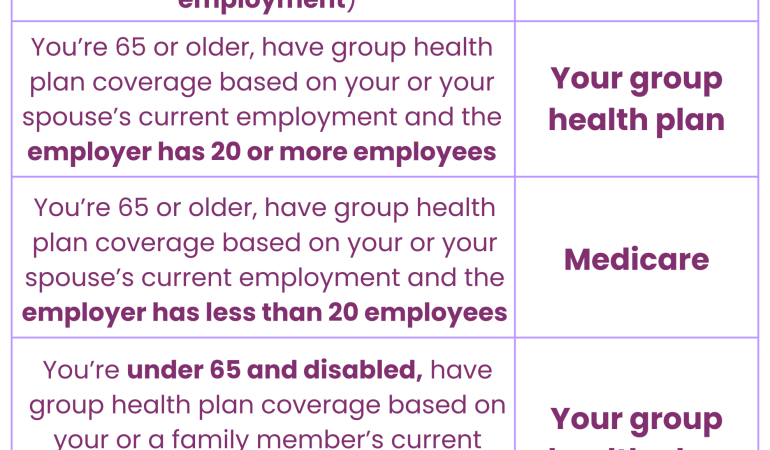
Scenario 2 — You’re 65+ With Employer Coverage From a Job With 20+ Employees
Primary: Employer Group Health Plan Secondary: Medicare
This is one of the biggest misconceptions. Many people think Medicare must pay first, but if the employer has 20 or more employees, the employer insurance is primary.
Scenario 3 — You’re 65+ With Employer Coverage From a Job With Less Than 20 Employees
Primary: Medicare Secondary: Employer group health plan
Small employers (under 20 employees) are allowed to make Medicare the primary payer.
Scenario 4 — You’re Under 65, Disabled, and Covered by a Job With 100+ Employees
Primary: Employer Group Health Plan Secondary: Medicare
When disabilities are involved, the employer-size threshold increases from 20 to 100 employees.
Scenario 5 — You’re Under 65, Disabled, and Covered by a Job With Less Than 100 Employees
Primary: Medicare Secondary: Employer group health plan
Small employers do not serve as primary when insuring disabled beneficiaries.
How Does Medicare Know You Have Other Coverage?
Medicare does not automatically track all your insurance. Instead, insurers are required to report when they are the primary payer.
Your doctor, employer, or insurer may ask you questions about other insurance when:
You enroll in Medicare
You receive care
Your job or spouse’s job changes
A claim needs clarification
This information is reported to Medicare so claims are processed correctly.
Why Getting the Order Right Matters
If Medicare should be primary — but your employer insurance was billed instead — the claim may be denied. If your employer should be primary — but Medicare was billed first — it can cause delays or incorrect balances.
Getting this wrong can affect:
Out-of-pocket costs
Medication coverage
Whether a provider will see you
Approval for certain services
As your Medicare broker, we help you understand exactly which insurance should be billed first — and fix it if something goes wrong.
Need Help Understanding Your Coverage?
This can get confusing, especially if you or your spouse is still working. Call or text us and we’ll walk you through your exact scenario.